
The short answer: timing is individual
There is no single safe number of weeks or months that applies to everyone after chemotherapy. The right time to consider a topper or extensions depends on your treatment plan, scalp condition, hair regrowth, sensitivity, and the type of coverage or volume you need.
Before scheduling a fitting, speak with your oncologist or treating medical professional about your specific situation. A salon consultation can help assess hair and scalp considerations, but it does not replace medical guidance. If your medical team has advised you to avoid added weight, tension, adhesives, or contact with the scalp, that guidance should come first.
- Some people explore a lightweight topper while hair is still growing back.
- Others wait until the scalp is comfortable and the hair has enough strength to support a chosen method.
- Extensions may require more natural-hair density and strength than a non-attached or integration-style option.
- A private consultation is appropriate when you are unsure whether coverage, volume, or a combination of both is the better starting point.
What should be checked before choosing a topper or extensions?
After chemotherapy, the appearance and feel of the hair can change during regrowth. Hair may be shorter, finer, more fragile, uneven in density, or different in texture than it was before treatment. The scalp may also feel sensitive or dry. These details affect how a solution should be fitted and worn.
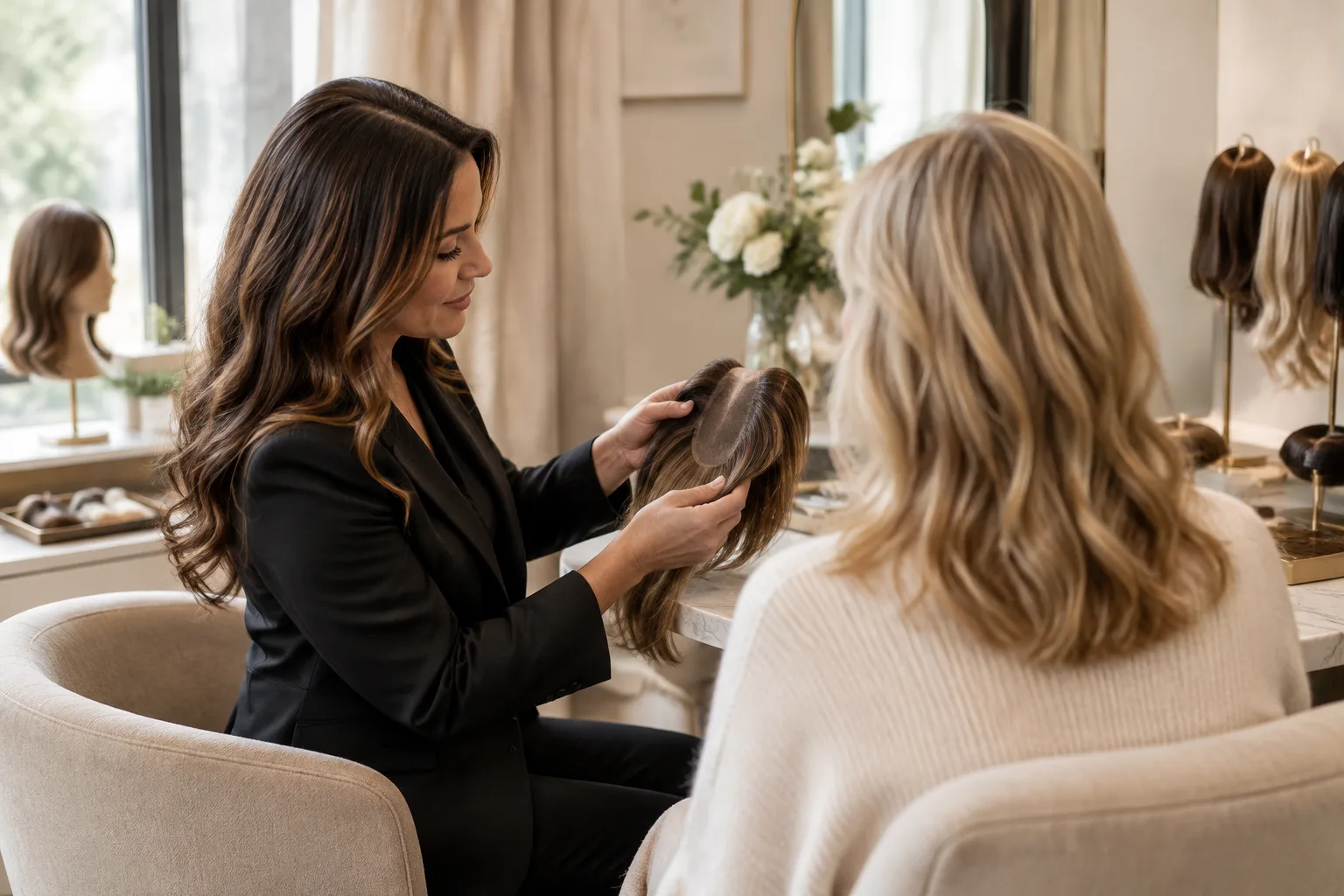
At Nasrin Salon, a consultation can focus on your current hair, the areas you want covered, your styling routine, and how discreet or flexible you want the result to be. The goal is not to rush into a method. It is to understand what your hair can comfortably support now and what may be more suitable later.
- Scalp comfort: Tenderness, irritation, dryness, or areas of sensitivity should be discussed with your medical team before a fitting.
- Hair density: A topper or integration system may be considered differently depending on where hair has returned and how much coverage is needed.
- Hair strength: Short or fragile hair may not be a good candidate for methods that rely on attachment, weight, or tension.
- Treatment status: Ongoing treatment, medications, or planned procedures may affect when a salon service is appropriate.
- Daily needs: Headwear, exercise, sleep, work, and styling habits can influence the most practical option.
Why a topper may be considered before traditional extensions
A topper is designed to add coverage or volume over a specific area, such as the crown or part line. For someone experiencing uneven regrowth or visible thinning after treatment, this type of solution may address the area of concern without requiring added length throughout the hair.
Whether a topper is suitable depends on how it is secured and the condition of the hair and scalp. Some clients may need a very lightweight, low-tension approach, while others may not yet have enough hair or scalp comfort for an attachment-based option. These decisions should be made individually rather than by assuming that one method is appropriate for everyone.
- Ask how the piece is secured and whether that method places tension on growing hair.
- Discuss how often it should be removed and whether your scalp needs regular breaks.
- Bring up any sensitivity to contact, pressure, adhesives, or friction.
- Consider whether you want temporary coverage for selected occasions or a solution for regular wear.
When extensions may be appropriate after treatment
Extensions add length, fullness, or both, but they are not automatically the best first choice after chemotherapy. Many methods depend on the strength, density, and distribution of the natural hair. If the hair is still very short, fragile, or sparse, adding weight or tension may be unsuitable.
Nasrin Salon offers several extension and hair-loss-solution consultations, including planning for K-Tip Hair Extensions, Invisible Beaded Weft Hair Extensions, Micro Bead or Micro Link Hair Extensions, Tape-In Hair Extensions, and V-Light Extensions. The availability and suitability of any method depend on an in-person assessment. For clients seeking broader coverage or a more integrated appearance, Mesh Integration System, Meshless Integration System, and Hairdreams MicroLines consultations may also be discussed where appropriate.
A consultation does not mean you must choose extensions. It can clarify whether your current priority is coverage, volume, length, or simply a comfortable transitional style while your hair continues to change.
- Do not use added hair to conceal scalp symptoms that need medical attention.
- Avoid choosing a method based only on photographs or a desired length.
- Expect the recommendation to change as regrowth develops.
- Ask about maintenance, removal, and how the method may affect your normal routine.
How to prepare for a private consultation in Plano
A private Hair Loss Consultation or Extension Consultation can be especially helpful when you want discretion and a calm setting. Nasrin Salon is located at 1805 Preston Rd, Suite 502, Plano, TX 75093, convenient for clients in Plano, West Plano, North Dallas, Frisco, Allen, and nearby North Texas communities.
Before your appointment, write down the date of your last treatment or any upcoming treatment plans, the areas where you notice the most change, and any scalp or hair concerns you have discussed with your medical team. You may also bring photographs of your preferred length or coverage, although the recommendation should be based on your current hair and scalp—not only on an inspiration image.
- Ask your medical provider whether there are restrictions relevant to salon services.
- Arrive with your hair in its usual condition unless the salon gives different instructions.
- Share any history of scalp sensitivity or discomfort.
- Be clear about whether you prefer coverage, fullness, length, or a temporary option.
- Ask how maintenance and removal would fit your schedule.
Care considerations once you begin wearing a solution
If you are cleared to wear a topper or extensions, gentle handling remains important. Follow the salon’s instructions for brushing, washing, drying, sleeping, and maintenance. Avoid pulling, tight styling, or continuing to wear a solution that causes pain or persistent discomfort.
Because regrowth can change over time, schedule reviews when recommended. A method that feels suitable at one stage may need adjustment as hair becomes longer, denser, or stronger. Contact your medical team about symptoms such as significant irritation, open areas, unusual pain, or changes that concern you.
- Remove or adjust the solution according to professional instructions.
- Use gentle handling around shorter or newly regrown hair.
- Never ignore ongoing pain, scalp irritation, or signs of skin breakdown.
- Reassess the fit as your hair and treatment circumstances change.
Frequently asked questions
How soon after chemotherapy can I wear a hair topper?
There is no universal waiting period. Ask your oncologist or treating medical professional first, then schedule a salon consultation when your scalp is comfortable enough to be assessed and you are ready to discuss options. Suitability depends on your treatment status, hair regrowth, scalp condition, and the way the topper is secured.
Can I wear extensions while my hair is growing back?
Possibly, but not every type of extension is appropriate during early or uneven regrowth. Extensions can add weight or tension, so natural-hair strength and density must be evaluated in person. A topper or integration-style solution may be considered instead, depending on your needs.
Should I wait until my hair is fully grown back?
Not necessarily. Some people explore coverage before full regrowth, while others prefer to wait. The important factors are medical clearance, scalp comfort, current hair condition, and whether the selected option can be worn without creating unnecessary tension.
Can Nasrin Salon tell me whether I am medically ready?
A salon consultation can evaluate hair, scalp-related comfort as observed during the appointment, desired coverage, and practical options. It cannot determine medical readiness or replace advice from your oncologist, dermatologist, or other treating professional.
What should I book at Nasrin Salon?
A Hair Loss Consultation is a useful starting point when coverage or regrowth is your main concern. An Extension Consultation may be appropriate when you are primarily considering added length or volume. The salon can help determine which consultation best matches your goals.